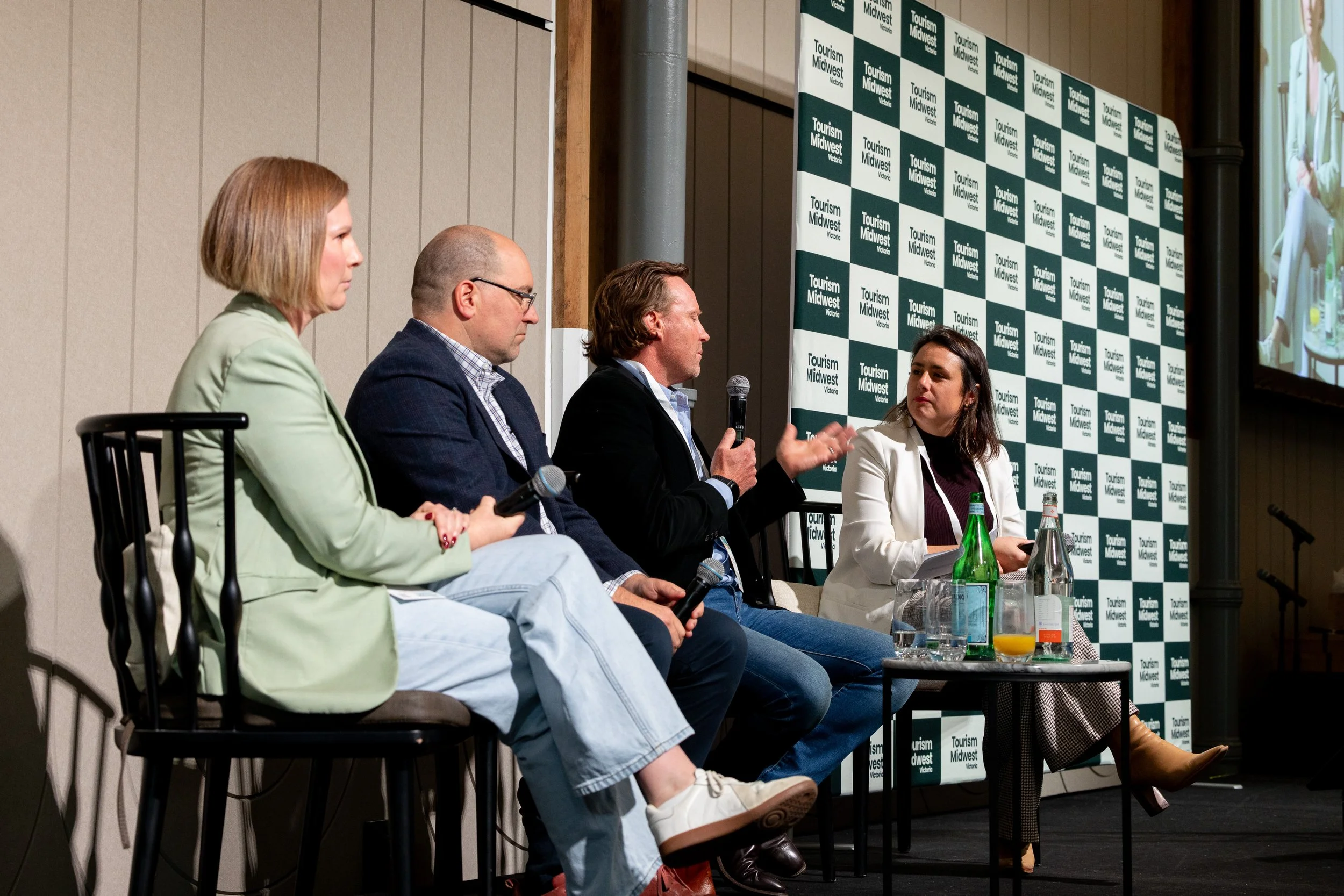
Hosting the AI panel with Katrine Taylor, Simon Coghlan and Tim Matthews. Photo: Tourism Midwest Victoria
Last month Tourism Midwest Victoria invited me to host an AI panel at its conference at The Goods Shed in Ballarat. The room was full of hospitality, food and tourism operators, and opinions on AI were divided. I understand why.
Few subjects are as polarising right now. Tech companies, and businesses looking to cut operating costs, are pushing AI hard. Employees and individuals are asking what it means for ethics, for their careers and for the world we live in. To me, it feels like the biggest technological shift of the modern era, bigger even than the arrival of the internet.
Food, drink and tourism are people-first industries, and plenty of the people I work with see AI as the opposite of that. I share their concerns, from ethics to the environment, and this piece can't settle them.
What it can do is set out my position as a consultant. For most small and medium-sized businesses, anything repeatable or process-driven, from admin to operations, can now be supported by AI. What follows are my recommendations if you decide to use it, drawn from my own experience and the many perspectives I've heard, including on that panel. Whether you do is up to you. The one place I hold firm is creative: I'm not advocating AI for your brand, your copywriting or your design.
A quick note on terms. When I say AI here, I mostly mean large language models, or LLMs: the chat tools you type or talk to in plain language, such as ChatGPT, Claude, Gemini and Microsoft Copilot. They're trained on vast amounts of text, which is how they can draft, summarise, analyse and answer questions.
My eight recommendations fall into two halves. The first four cover what AI should and shouldn't do inside your business. The other four cover how customers will find you as more of them ask AI where to eat, drink and stay.
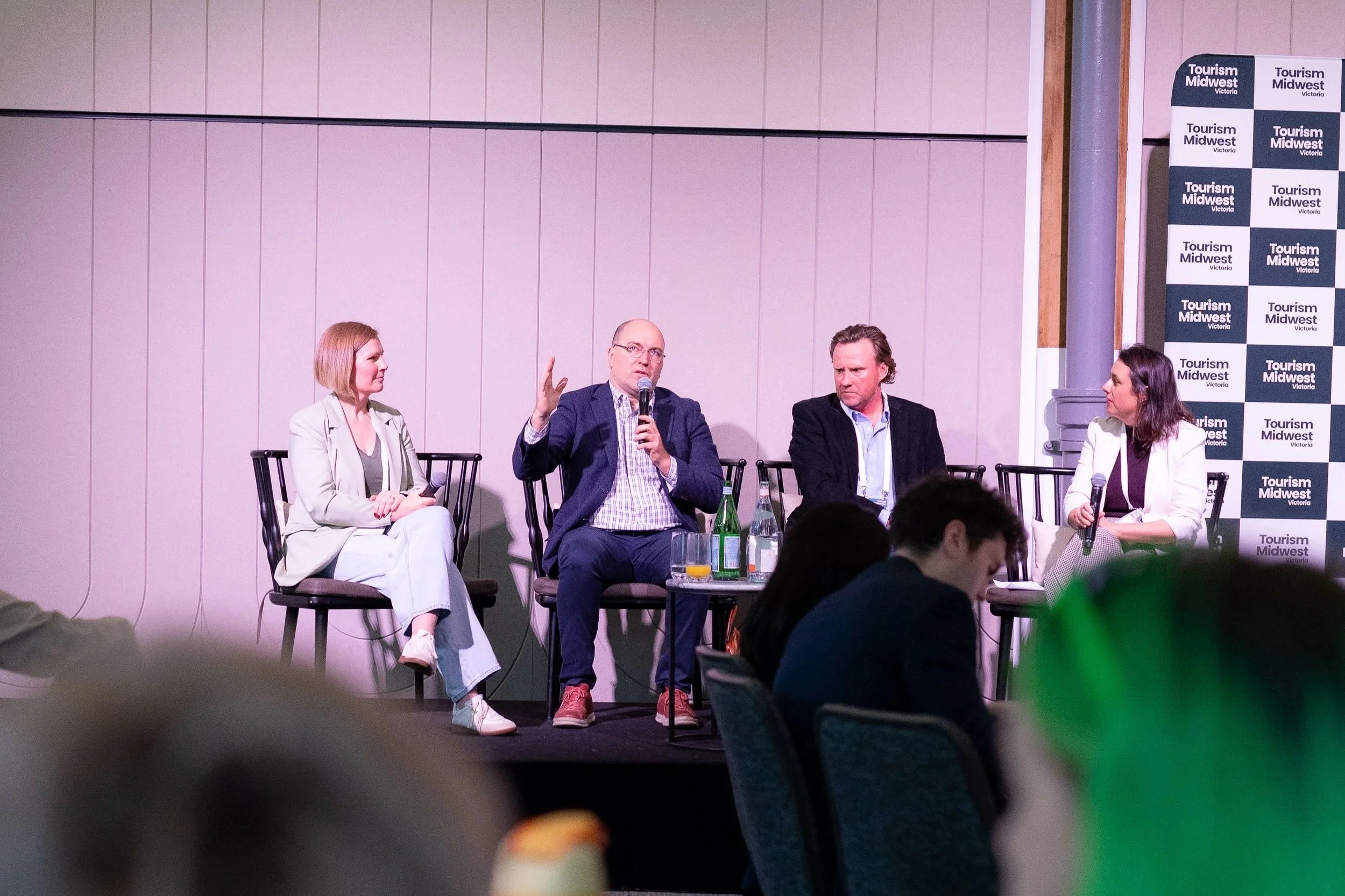
The AI panel at the Tourism Midwest Victoria conference, The Goods Shed, Ballarat. Photo: Tourism Midwest Victoria
1. Start with the jobs that eat your time
My three panellists at the conference covered the full range of experience. Katrine Taylor runs Maggie & Kate in Buninyong on her own and was candid about how daunting it felt to start. Her stock system, Restoke, now checks supplier prices as deliveries arrive, so she can adjust a recipe or menu price before a rise hits her margin. Simon Coghlan, 30 years into Ballarat hospitality and now at The Buninyong Hotel, is just getting started, using free tools to review contracts and financial reports. Tim Matthews of The Forge Pizzeria and 1816 Bakehouse is further along: he used AI to build a small program that prints his chef's bookings at 5pm every night.
Each of them started with a job that was costing them time, rather than with the technology itself. It's the same advice Julie Fenwick gave when she joined me on The Growth Edit to talk about AI: list the friction points, bottlenecks and time sucks in your business, then see where AI can take some of the load. A multi-venue cafe owner I heard speak at a Melbourne Food and Wine Festival hospitality conference did exactly that. His supervisors were ringing him all day with the same questions (we've all been there), so he loaded the most common ones into an AI tool on a tablet at the pass. Now staff ask it before they call him.
If an operator eager to adopt AI, and happy to pay for a business account, came to me, this is where I'd start:
Documenting and systemising how the business runs. Proper business documentation, from opening procedures to how you run an event, has always been heavy admin that most operators never get to. Now you can talk it through in voice notes and have AI turn them into processes your team can follow.
Planning and admin. Diary management, rosters, timelines and content planning.
The numbers. Look at the AI tools and add-ons available for Xero, and use AI to read your point-of-sale and stock reports side by side, so you can see which items are driving your margin.
2. Set AI up properly before you judge it
Two concerns came up during the session: that briefing AI takes so long it isn't worth the effort, and that it "hallucinates", confidently making things up. Both are fair. In my experience, though, the tools are improving fast, and most of the frustration comes down to how you set them up and the information you give them. Check anything factual before you rely on it, as you would with any first draft.
Treat AI like a new team member and design a proper induction. Give it context about your business, your customers and your goals, and expect to repeat yourself while it learns, as you would with any junior hire.
For digitally savvy businesses, I'd go a step further and bring in an AI consultant to set up a "brain" for the business, with your documents, frameworks and tone of voice in one place, so every task starts from what the business already knows.
Two housekeeping rules came up both on the panel and in my interview with Fenwick. First, pay for a business account if you're uploading anything about your business. Matthews puts the cost at roughly $30 a person a month, and on ChatGPT's business plans OpenAI doesn't train its models on your data by default. Second, strip names, emails and phone numbers out of customer data before you upload it. And before you run any analysis in an LLM, do your due diligence on privacy law and how it applies to the customer data you hold.
3. Keep people on your brand
Just because you can generate a poster with ChatGPT doesn't mean you should.
This is where I draw a firm line. AI can help you plan and work through marketing planning frameworks, but I am not advocating tools like ChatGPT or Claude for developing your creative, your copywriting or your design.
Most of us in food and wine are selling to customers who are spending discretionary money. A long lunch, a case of wine or a weekend away is a luxury, and luxury depends on brand. To win that spend we have to engage people emotionally, and AI-generated copy and design cannot do that. Our industry is built on culture, and AI doesn't understand culture. Rely on it entirely and you lose the magic that makes someone choose you.
Customers can tell. If my 10-year-old can pick a poster made in ChatGPT, so can your customers, and it won't cut through. Research on tourism imagery backs this up: across three experiments, AI-generated images reduced perceived authenticity and people's intention to visit, compared with photographs taken by people.
The tourism bodies take the same view. Tourism Midwest Victoria has published a position against using AI-generated images to promote the region, and in my experience state and regional tourism bodies won't promote AI-generated imagery either. If you want them to share your content, show the real place, the real people and the real produce, and keep your designers, copywriters and photographers on anything a guest sees. If you market alcohol, check the industry's advertising code guidance on AI-generated content too.
4. Invest in what only people can give
As more marketing content becomes commoditised and generic, I believe human-led creative and in-person brand experiences, from events to lifestyle activations, will be the difference between the lifestyle brands that thrive and the ones that fade. That's where I'd put the budget and attention AI frees up.
The same goes for time. If AI saves you a few hours a week on costings, rosters or admin, spend those hours on the floor, at the cellar door and with your guests. Being looked after by another person will become something people seek out and pay more for, and our industry is uniquely placed to give them that.
Being looked after by another person will become something people seek out and pay more for.
5. Claim your business in ChatGPT
Ask ChatGPT or Claude for the best winery lunch in your region, or the best place to eat in your town. You'll get a shortlist of a handful of places. Is yours on it?
We didn't have time to cover this side of AI on the panel, but it's the one I'd prioritise. Roy Morgan research found that 10.5 million Australians aged 14 and over, almost half that age group, used ChatGPT in an average four weeks in the March quarter of 2026.
Google is moving the same way. AI Mode launched in Australia in October 2025, building on the AI Overviews that already sit at the top of many search results. You already know how you show up on Google. You now need the same picture of where you show up in AI answers, whether on Google, ChatGPT or Claude.
The easiest place to start is ChatGPT's new business listings. On 10 November, OpenAI launched Businesses in ChatGPT in beta. It works much like a Google Business Profile: through a new Business Hub you can claim your listing, correct your details, and see how often you're mentioned and how many people click through. It's free, for now. When I searched Business Hub for my Australian clients, every one of them already had a listing.
ChatGPT is describing them whether they've claimed it or not.
To claim yours, sign in on the web with a shared business login, open Business Hub from the sidebar, find your listing and verify it by business phone, email, website domain or Shopify. An ID check follows, so have your legal name, address and ABN ready, matching official records. Write a description of about 300 characters in your customers' words, choose the narrowest category that fits, and check your mentions and clicks every month.
6. Build the reputation AI reads
Claiming your listing won't push you up that shortlist. OpenAI says paying doesn't change how often ChatGPT recommends a business. The recommendation comes from everything said about you online: your reviews, your Instagram captions, Reddit threads, travel forums, Wikipedia and credible media.
Start by finding out where yours comes from. Ask ChatGPT, Claude, Gemini and Google's AI Mode the questions your customers would ask, note the sources they cite, and look at the Reddit threads, forums and Tripadvisor pages that come up.
Reviews carry much of that weight, so they deserve more attention than many of us have given them. Give reviews a place in the weekly plan and someone who owns them, as you would social media. Ask every guest for one, reply to every review, and know the consumer law before you start. To be crystal clear: reviews matter to LLMs, but that is no licence to fake them.
7. Make every post and press brief citable
My roots are in PR, and as this piece has argued, online word of mouth and earned reputation matter as much as ever, if not more. Your reputation, and how LLMs rank you, now decides whether you're found, and your own channels and coverage feed the answers they give.
Every post a guest makes about you, and every Instagram check-in at your venue, is citable content. On your own posts, say what you are, where you are and who you're for, using the words a traveller would type, such as your region, your varietals or the experience you offer.
Brief your publicist or agency beyond traditional media too. Credible outlets still matter, but a good brief now also covers your reputation across Wikipedia, Reddit and the forums.
8. Keep your trading information consistent
The shift doesn't stop at recommendations. In June, IAB Australia published a report on agentic AI describing AI's move from finding information to completing tasks on our behalf, so discovery, consideration and purchase can happen in seconds. OpenAI's new Business Agents, which answer customer questions on a brand's behalf inside ChatGPT, are an early example, available for now only to US online businesses.
The marketing funnel we've planned around for years is collapsing into a single step. An agent that finds you in a ChatGPT itinerary can click straight through to your website and book. If I were planning a business's growth over the next 10 years, being found, rated, chosen and booked by an agent is where I'd put my energy. For almost every business I work with, building credibility online deserves as much budget and attention as paid advertising.
An agent can only book you if it trusts what it reads. Your location, hours, experiences and how you describe them should match across your website, Google profile, booking platforms and tourism listings. If they disagree, AI won't trust any of them.
Your business, your call
Whatever you decide about AI, and I appreciate it's not for everyone, please don't ignore how it's changing search and the way prospective customers discover you.
Most wineries and hospitality brands can't afford a generative search specialist, and they don't need one. What they need is a marketing plan written by an experienced practitioner who understands AI and how it works alongside brand, PR, digital, communications and the guest experience. That's the mix I work across in this sector, and it's what I'll be building into every strategy I write from 2027.
Holly Formosa is a growth strategist for wine, food, hospitality and tourism businesses, and the founder of Holly Formosa Consulting. This article is general advice. To work out where your business stands, book a free 30-minute growth call, or start with the free tools in Growth Insights.